M-Pesa and Mobile Money in 2026: $2.1 Trillion and the Border Gap
Mobile money moved $2.1 trillion in 2025, two-thirds of it in Sub-Saharan Africa. A look at M-Pesa, the GSMA data and why cross-border flows still lag.


Key takeaways
- Mobile money processed $2.1 trillion in 2025 across 2.3 billion registered accounts, with Sub-Saharan Africa accounting for about two-thirds of value.
- M-Pesa handled Ksh41.68 trillion in the year to March 2026, and merchant payments are now the fastest-growing mobile money use case globally.
- Cross-border mobile money reached $45 billion in 2025, but Sub-Saharan Africa remains the most expensive region to send money to.
A shopkeeper in Nairobi's Eastleigh market probably handles more digital payments in a week than a corner shop in many rich countries. Mobile money, which began as a way to send airtime-like credit by text message, moved $2.1 trillion in 2025. Most of that happened inside single countries. The next chapter, getting it across borders cheaply, is proving much harder.
The scale in one paragraph
The GSMA's State of the Industry Report 2026 counts 2.3 billion registered mobile money accounts worldwide, up 268 million in a year, the biggest annual jump on record. Some 593 million were active in a given month. Transaction value rose 23% to $2.1 trillion. Sub-Saharan Africa accounted for about two-thirds of that value, roughly $1.4 trillion, and more than half of all registered accounts. There are 347 live services in 102 countries.
How mobile money works
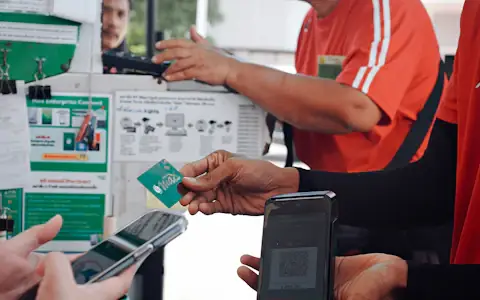
Mobile money is a wallet held by a telecom operator or its licensed subsidiary, tied to a phone number. The money behind it sits in trust accounts at commercial banks. Customers turn cash into e-money at agents, small shops that act as human ATMs, and then send it, spend it or pay bills from a basic phone menu or an app.
The agent network is the part outsiders underestimate. There were 30 million registered agents in 2025, 11 million active each month, and they cashed in $430 billion. In places where the nearest bank branch is a bus ride away, the agent is the bank.
- Correspondent bankingGlobal reach, highest cost1 to 5 business days
- ACH and batch transfersCents, business days onlySame day to 3 days
- Card networksAbout 1.59% average to US merchantsSeconds to approve, 1 to 2 days to settle
- Instant systems (UPI, Pix, FedNow)Mostly domesticSeconds
- Stablecoins on public blockchainsGlobal, needs on and off rampsSeconds to minutes, 24/7
FasterSlower
Source Nilson Report 2025 card fees; Nacha; Federal Reserve; NPCI; BIS. Bar length shows relative settlement time.
M-Pesa: the reference case
Safaricom's M-Pesa, launched in Kenya in 2007, remains the best-known example. In the year to March 2026 it processed Ksh41.68 trillion in transactions, People Daily reported. M-Pesa revenue rose 13.4% to Ksh182.7 billion, making up 45.6% of Safaricom's Kenyan service revenue. The group counted 43.69 million active M-Pesa customers, and its newer Ethiopian business reached 5.2 million 90-day active users, more than double the previous year, according to HapaKenya.
Kenya also shows why the model is hard to copy. M-Pesa arrived when Safaricom already dominated mobile phones in the country, banks were thin on the ground outside cities, and regulators chose to let the service grow before writing detailed rules. Few markets line up all three conditions at once, which is why some mobile money launches elsewhere stalled for years before finding their footing.
The interesting shift is what people use it for. Ten years ago M-Pesa was mostly about sending money home from the city. Today the growth is in merchant payments, overdraft-style credit, savings and insurance. Safaricom itself names wealth, insurance and merchant solutions as the next engines.
Merchants are the new frontier
Globally, merchant payments were the fastest-growing use case in 2025, up 42% to $155 billion, the GSMA says. That matters because it keeps money inside the digital system. Every time a customer pays a shop from a wallet rather than cashing out, the operator avoids the cost of an agent cash-out, and the merchant avoids handling notes.
Interoperability has helped. Transfers from banks into mobile wallets reached $167 billion and wallet-to-bank transfers $163 billion. The wall between bank accounts and mobile money, once a defining feature of African finance, is getting thinner.
Mobile money solved the domestic problem. Moving money between countries is a regulatory puzzle, not a technical one.
For a small trader, that changes the economics of a day. A vegetable seller who takes wallet payments all morning can pay her supplier from the same balance at noon, without a trip to an agent and without carrying cash home.
The cross-border gap
International remittances through mobile money rose 23% to $45 billion in 2025, across 381 million transfers. That is meaningful, but small next to $2.1 trillion in total value. Most cross-border money into Africa still travels through banks and money transfer operators before landing in a wallet.
The cost shows it. The World Bank's Remittance Prices Worldwide data for early 2025 put the average cost of sending $200 to Sub-Saharan Africa at 8.78%, the highest of any region, against a global average of 6.49% at the time (6.36% in the later Q3 2025 data). Digital transfers averaged 4.85% in that quarter, which is part of why mobile money matters for African remittance costs.
Kenya illustrates the stakes. The country received about $5.04 billion in diaspora remittances in 2025, with roughly half coming from the United States, according to Central Bank of Kenya data reported by ITWeb Africa. Growth slowed to under 2%, the weakest in more than 15 years.
Why is cross-border so hard? Each country has its own e-money rules, its own foreign exchange controls and its own data laws. The GSMA found 24% of providers said rules on transferring data across borders had hindered their operations. Two wallets in neighbouring countries may each work perfectly at home and still be unable to talk to each other without a bank, an FX dealer and a compliance team in between.
Where stablecoins come in
This is the gap that dollar stablecoins are trying to fill. A sender in Johannesburg could, in principle, move a dollar token to a recipient in Lagos in seconds for cents, with conversion to local currency at either end. Some fintechs already use stablecoins behind the scenes to settle between African corridors. The hard parts are the same ones mobile money faces: local licensing, cash-out liquidity and regulators wary of dollarisation. Technology alone will not close the gap, but it may lower the cost of the settlement leg.
What to watch
- Activity, not accounts. Almost three-quarters of registered accounts are inactive in a given month. The 25.7% monthly activity rate is the number that shows real use.
- Regional payment systems. Pan-African and regional switches that connect wallets across borders could make the $45 billion figure grow much faster.
- Ethiopia. A large, newly opened market where M-Pesa is still early is a live test of whether the Kenyan model travels.
Mobile money is no longer an emerging-market curiosity. It is one of the world's largest retail payment networks, built on phones and corner shops. The question for the next five years is whether it can do for cross-border payments what it already did for the trip from Nairobi to the village.
Frequently asked questions
How big is mobile money globally?
According to the GSMA, mobile money processed $2.1 trillion in 2025 across 2.3 billion registered accounts, of which 593 million were active in a given month.
How much money does M-Pesa process?
M-Pesa processed Ksh41.68 trillion in transactions in Safaricom's financial year ended March 2026, and generated Ksh182.7 billion in revenue.
Can mobile money be used for international transfers?
Yes, and international remittances through mobile money reached $45 billion in 2025. However, most cross-border money still passes through banks and transfer operators because of differing national rules on e-money, foreign exchange and data.
Sources and further reading
- The State of the Industry Report on Mobile Money 2026 - GSMA
- M-PESA processes Ksh41.7T in a year - People Daily
- Safaricom hits historic Ksh 118.4B net profit - HapaKenya
- Kenya remittances hit $5bn in 2025 as growth slows - ITWeb Africa
- Remittance Prices Worldwide, Q1 2025 - World Bank
This article is for general information and is not financial, legal or tax advice. Figures are as reported by the sources above at the time of writing.